THE GEORGE MASON UNIVERSITY STUDENT TEAM USING ROBOTICS TO RETHINK ACCESSIBILITY
Most accessibility surveys continue to depend on manual measurements, handwritten notes, and extensive walkthroughs with compliance checklists.
A team of George Mason University engineering students wondered if a robot could do it faster. Nine months later, they created one.
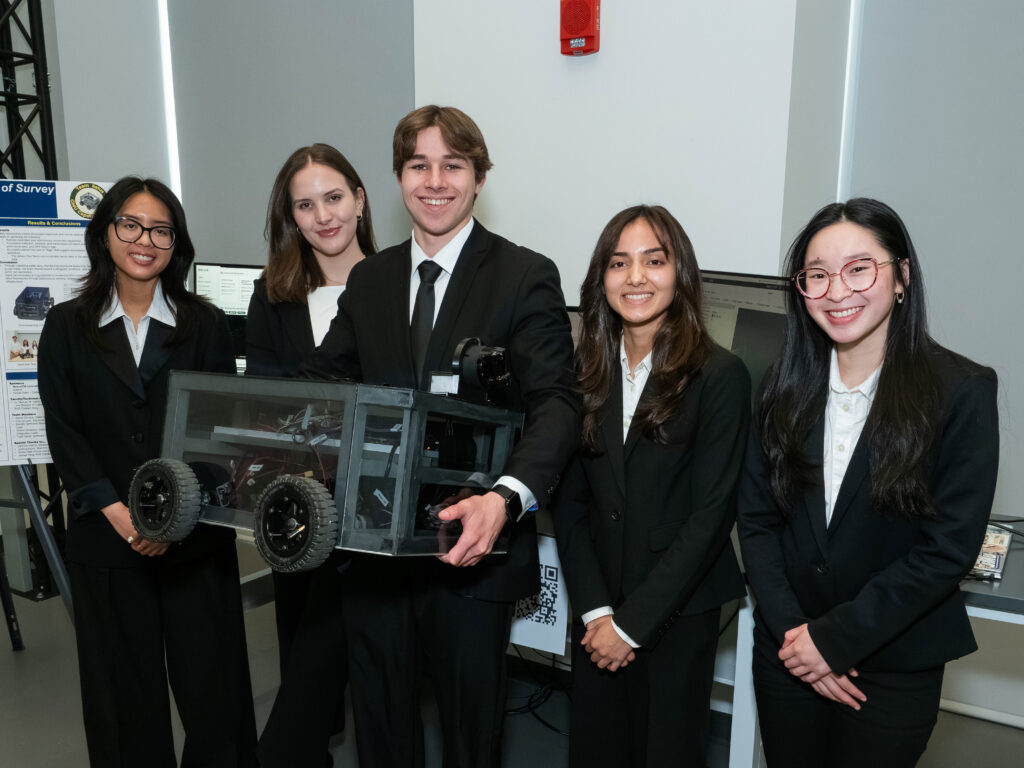
The project, called Salus, combines robotics, LiDAR technology, object detection, GPS mapping, cloud-based analytics, and a custom-built website to help survey public spaces for potential ADA accessibility barriers. Developed as part of a senior capstone project by students Lexi Chivers, Connie Lam, Mariah Tammera, Noemi Umanzor, and Tyler Yared, the system is designed to automate portions of the accessibility surveying process while allowing engineers and designers to better understand how people with disabilities experience physical spaces. Salus was one of several George Mason capstone projects supported through a GO Virginia-funded initiative led by the Nexus234 Innovation District, which pairs students with industry-informed challenges and mentors.
“We saw a system that was operating poorly, and we wanted to optimize it,” said Chivers, the team lead.
The idea originated when one of Chivers’ teammates attended a conference and discussed the difficulties of collecting large volumes of survey data in the field with industry professionals.
“They basically said, ‘We wish we had something we could send out to collect data and not have to constantly manage,’” said Chivers. “That conversation sparked everything.”
The project consumed most of the team’s weekends as they worked through testing, software integration, fabrication, and constant iteration.
“A lot of people told us we weren’t going to be able to do this in nine months,” said Chivers. “At one point, someone told us it would take two years and eight NASA engineers.”
Instead, the students delivered a working proof of concept before graduation.
As the robot moves through a space, it uses LiDAR sensors, GPS mapping, and onboard cameras to identify and document potential accessibility issues. The data is processed through cloud-based systems and displayed through an interactive website. Rather than sorting through raw data, users can explore flagged locations through an interactive visual map built by the team.
For Chivers, the project also had a personal connection. She said her mother’s job teaching students with disabilities influenced the team’s conversations around accessibility and inclusion.
“Just because something legally meets ADA standards doesn’t always mean it’s truly accessible for those with disabilities,” said Chivers.
Kenan Aden, COO of Didlake and the team’s industry mentor, who was introduced to the students through Nexus234’s initiative, said the project impressed him not only for its technical complexity but for the problem it set out to tackle.
“The entire team approached this project with an incredible level of determination and systems thinking,” said Aden. “What makes it especially meaningful is that they never lost sight of the people this technology is intended to help.”
Currently, the students are working with George Mason’s Office of Technology Transfer to explore patent protection for the project’s intellectual property. Although the team is still deciding what comes next, Chivers said the technology has potential beyond the capstone project itself, including with construction firms, municipalities, designers, and accessibility planners.
“This team’s focus and dedication have been extremely impressive,” said Leigh McCue, professor and chair of George Mason’s Department of Mechanical Engineering. “Any time I popped my head into the senior design space, or walked visitors through for a tour, the team was hard at work and eager to showcase their technology.”
One of the most rewarding parts of the experience for Chivers was discovering the kind of engineer she wants to become.
“I thought I wanted to stay in the background,” said Chivers. “But this project made me realize I really love being a leader, solving problems, and doing things that actually matter to people.”
Now that graduation is complete, the team is moving on from the project, which Chivers calls a bittersweet moment. However, even as the future of Salus continues to evolve, she hopes readers take away one message from the project:
“Your dreams are never too big. You just haven’t found all the tools you need to make them happen yet.”