
THE CENTER FOR MEDTECH INNOVATION: ENGINEERING THE FUTURE OF MEDICAL TECHNOLOGY
Discovery is only the beginning at George Mason University’s Center for MedTech Innovation (CMI). Recently rebranded, applied, user-driven technologies now define an initiative that is not confined to traditional research boundaries.
“Our focus is on translating cutting-edge research into real-world impact,” said Siddhartha Sikdar, co-director of CMI and a professor in George Mason’s Department of Bioengineering. “At CMI, that work happens in close collaboration with the individuals and community partners who are directly affected. We take that responsibility seriously.”
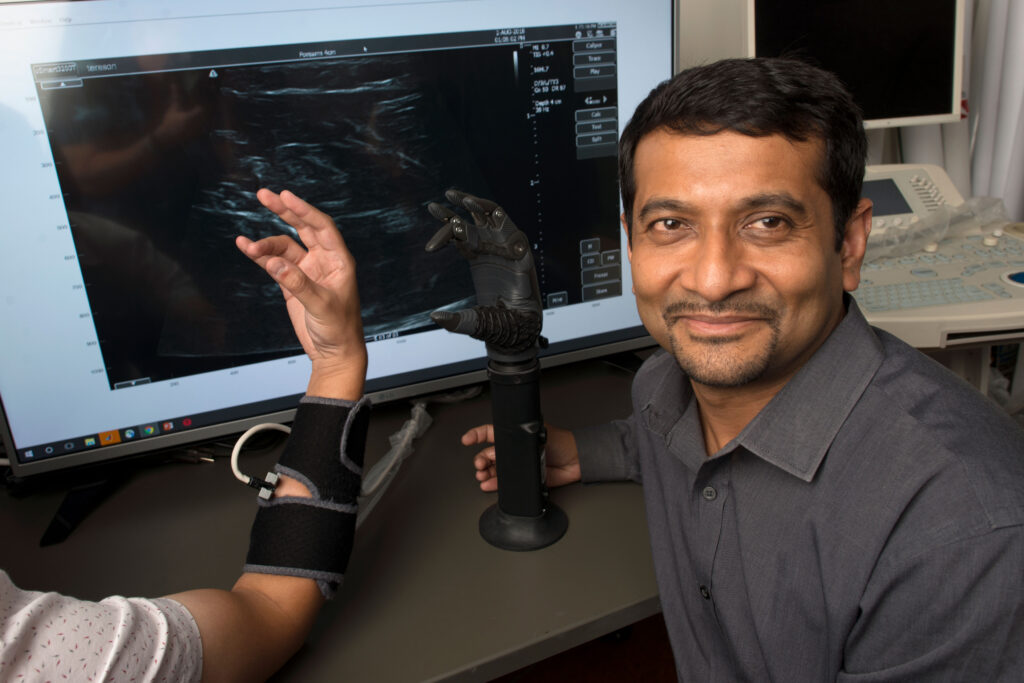
At CMI, researchers, clinicians, engineers, and community stakeholders work side by side to design the next generation of medical devices and technologies that address complex healthcare and societal challenges. This includes advancing solutions for chronic conditions and injuries that are among the leading causes of disability and financial burden.
Formerly known as the Center for Adaptive Systems of Brain-Body Interactions (CASBBI), CMI serves as a key link between scholarship and implementation at George Mason. Conventional academic outputs mark a step for the center, not an endpoint, as findings go on to deliver meaningful outcomes.
“Effective innovation extends far beyond the university, supporting economic vitality, improving quality of life, and bringing new technologies to the patients and practitioners in the medical community,” said Paula Sorrell, associate vice president of Innovation and Economic Development at George Mason.
That strategy is reflected in several projects underway.
“We’re currently investigating a novel contrast agent for photoacoustic imaging, and it’s a good example of why entrepreneurial partnerships matter,” said Remi Veneziano, a member of CMI and an associate professor in George Mason’s Department of Bioengineering. “There’s a long path from lab development to clinical use, and entrepreneurs help us understand the broader ecosystem, including market demand, regulatory considerations, funding, and commercialization, so the technology can ultimately make an impact outside the research setting.”
CMI also plays a role in shaping future researchers. Trainees navigate through everyday challenges, gaining experience with how projects are used to address pressing needs. Senior roles have followed for some. At Myokinetics, Inc., founded by CMI co-directors Parag Chitnis and Sikdar, Erica King, a former trainee who earned her PhD in bioengineering from George Mason in 2025, now serves as chief executive officer.
“My experience with CMI fundamentally influenced the way I do my work,” said King. “Exposure to multiple disciplines taught me how to translate technical ideas for different audiences and to create technologies from the user’s perspective. Those skills carried directly into my research and, in turn, into building a company aimed at interventions that people will actually adopt.”
CMI is part of the Nexus234 Innovation District. The surrounding district provides the space and infrastructure firms require to evolve over time.
“Nexus234 offers companies a range of environments that align with different stages of maturation,” said Helena Kondow-McConaghy, a business development manager for Prince William County’s Department of Economic Development and Tourism. “Organizations can begin in spaces like Endeavor, with access to wet lab and shared R&D resources, and later move into larger sites across the district as their operations scale.”
At its core, CMI is structured around what comes next. It’s an approach that keeps research progressing long after the initial question is asked.